Showing posts with label Dice Games. Show all posts

Monday, April 27, 2009

Shut the Box

Preview

Shut the Box (also known as Canogo, Plug the Leaks, Tric-Trac, Batten Down the Hatches, and many others) is an old dice game for any number of players. It’s a common “pub game” and is often played for money, although this of course isn’t necessary to enjoy it. There are many variations on the game, but I will be presenting the most common rules.

Pieces

The game is typically played with some sort of contraption -- the titular “box” -- with the numbers 1-9 presented in such a way that they can be covered up. There are many mechanisms for doing this, some quite elaborate, and all completely unnecessary. You can print a free board here and simply cover the numbers up with tiny animal skins and tree bark (or whatever else you have handy). Or you could just make one yourself. It’s really not that hard.

Add two standard dice to that and you’ve got yourself a game. Maybe a dice cup if you want to get fancy, and a dice tray if you’re really up there. Or not.

Rules

The game can be played with any number of players, who will take turns rolling dice and covering numbers (or plugging leaks or what have you). Players roll the dice until they cannot cover any more numbers, at which point they receive a score based on the number left uncovered and pass the dice to the next player, who starts the process over. The lower your score (that is, the more numbers covered) the better.

Now, how you decide which numbers can be covered depends on what you roll. You must cover numbers in such a way that the sum of all the numbers covered is equal to the sum of the two dice. That’s an ugly rule, so let’s try an example: say the dice showed 4 and 1. The sum of that is 5, so you would have to cover a set of numbers that add up to 5. Any of the following would be valid:

  • 5
  • 4 + 1
  • 3 + 2

If you rolled a 6 and a 4, you’d have a slightly wider range of choices:

  • 9 + 1
  • 8 + 2
  • 7 + 3
  • 7 + 2 + 1
  • 6 + 4
  • 6 + 3 + 1
  • 5 + 4 + 1
  • 5 + 3 + 2
  • 4 + 3 + 2 + 1

Note that there’s no partial covering -- you either cover numbers to add up perfectly to the value of your roll or you don’t cover any numbers at all. If you can’t cover enough numbers to make the proper sum, you’re out of luck, and your turn is over. Whatever numbers you were unable to cover are summed and added to your score.
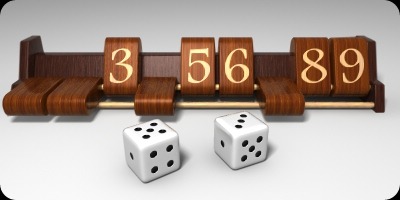
Choices The only available choices are 8 and 3 + 5

If you’ve already covered up the 7, 8, and 9, you can choose to only roll one die instead of two. You don’t have to, but it might be useful depending on your situation. Note that if any of those haven’t been covered, you must roll two dice.

The game is played for a certain number of rounds, and at the end of all the rounds the player with the lowest score is the winner. For a group of people this could be as few as one round; for two players you could do as many as ten -- it just depends on how long you want the game to last.

The game can also be played as a solitaire game -- just see how low you can get the score after a certain number of rounds, or see how quickly you can shut the box.

Wednesday, April 22, 2009

Mia

Mia

Mia is a neat, simple little dice game. It’s a bluffing game that’s best with a group of people. Although luck is something of a factor, it’s mostly about lying, which is always fun.

Pieces

All you need are two standard six-sided dice and a dice cup (or something with which to hide the dice). Also, some kind of counter for players to keep track of their lives. Or each player can just use a die, which works. Or pennies. Whatever.

Rules

You should decide before the game starts how many lives you will play with. The number should depend on the number of players you have -- for a lot of people, starting with 3 lives will keep the game shorter, but for only a few, you might want to go with 6. This all just depends on how long you want to play.

The game starts with one player rolling the dice and looking at them, making sure that no one else sees. He then announces a score to the rest of the players -- not necessarily the score shown, though (more on scoring later). You can lie and announce a higher or a lower score if you want.

The dice then pass to the next player. He has a choice: he can either believe the previous player and re-roll the dice or call his bluff and look at the dice. If the dice show a lower score than he announced then the liar loses a life. However, if the previous player wasn’t lying, or if he declared a lower value than the actual roll, the accuser loses a life.

If you choose to believe the previous person and re-roll the dice without looking, you must declare a higher score, even if it means lying. You can still declare something lower than the actual amount, so long as it’s higher than the previous roll (or supposed roll).

But there’s one other choice that adds some strategic subtlety: if you think that the previous player was lying with a lower number than he actually rolled, you don’t have to re-roll the dice at all. Just declare a higher number without looking or rolling and hope for the best. You are still responsible for the number you declare, however, so if the next player calls your bluff you’re the one losing lives.

Now, when someone declares a “Mia” (described below), things change a little bit. Mia is the highest roll possible, so there’s no way the next player could beat it. They instead must accept the call, losing a life, or call the previous person a liar. If they’re right, the liar loses two lives. If they’re wrong, however, they lose two lives.

After someone loses a life, either by rightly accusing, wrongly accusing, or getting Mia’d in the face, a new round starts, and whoever was up to play next gets to start it. Once a player loses all of his lives, he’s out of the game. Play continues until there is only one man standing.

Scoring

The trickiest part of the game is probably the scoring. You don’t add the dice up, instead the score is formed with the higher of the two dice as the tens digit and the lower as the ones digit. So a three and a five would be 53, a six and a one 61, two threes 33, etc.

But it isn’t just about getting the highest score. Rather, the scoring works like this: doubles come first, with lower doubles beating higher doubles. So a 22 beats a 66. Then come the “mixed” numbers, which beat all lower mixed numbers. So a 64 beats a 53, but any double beats any mixed number.

But there is one exception: a roll of 21 (a two and a one) is called a “Mia” and it beats every other roll, period.

So, just for example: 11 beats 53, 44 beats 55, 66 beats 43, 43 beats 32. Everything beats 31. Nothing beats 21. Or if you prefer it more precisely:

21 > 11 > 22 > 33 > 44 > 55 > 66 > 65 > 64 > 63 > 62
> 61 > 54 > 53 > 52 > 51 > 43 > 42 > 41 > 32 > 31

And there you have it.

Dice A gratuitous dice shot. Oh yeah. Check out the pips on that one.