Showing posts with label Solo Games. Show all posts

Monday, May 11, 2009

Peg Solitaire

Peg Solitaire

This is the original “Solitaire” game, and for centuries it went by that name alone. About twenty years ago, however, that changed, with the advent of Windows 3.0 and a simple computer version of Klondike, a solitaire card game, which went on to become the most played computer game of all time (by many accounts). Since then Solitaire has taken on a completely different meaning, and hardly anyone has even heard of the name “Klondike.”

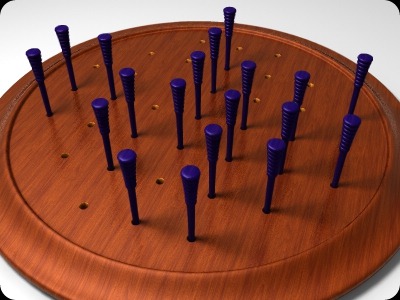
Thus we now know this classic game as Peg Solitaire, in reference to the fact that most physical versions use pegs in holes rather than pieces on a board. This has a few advantages, although the main one is that the game can be picked up and moved around without the pieces all falling off. There is no actual need for pegs, however -- just as you can play Checkers with a pegged board if you wanted to, you can just as easily play Peg Solitaire without one. I’ll be referring to the pieces as pegs, but it’s important to remember that this is an entirely arbitrary label.

Equipment

There are two main types of boards, the English and the European. Each has a different number of holes and thus requires a different number of “pegs,” for which you can just substitute pennies or checkers or stones or whatever. The English requires 32 and the European 36. As always, you can print out the boards for free by clicking on the links above.

European Board A European board

Rules

The game is very simple: the board starts completely filled with pegs. You then remove one of the pegs from anywhere on the board, and try to remove the rest of the pegs by simply jumping them over one another. A piece jumps over an orthogonally adjacent piece to an empty space just beyond it (read: exactly the same as every other jumping game). The piece that was jumped over is removed from the board.

You keep doing this for as long as possible. If you manage to remove all the pegs but one from the board, you win -- although a proper victory requires that the last peg occupy the same space that started empty at the beginning of the game. So if you had originally removed a piece from the center, your final peg would have to be in the center for you to get the “full” victory. Even a shallow victory, though, is something to be proud of.

Loss How do you even suck this badly? That’s just awful.

If there are no more available jumps but you still have more than one peg on the board, you lose the game. The fewer pegs you have left the better, though. Don’t beat yourself up just because  you can’t finish -- getting down to just two or three pegs is still pretty impressive.

It’s important to note that not all starting spaces can be won. If you can’t beat the game with a particular space starting empty, try another one. Most notable, perhaps, is that the game is not winnable if you start with an empty center on a European board. It has been mathematically proven to be impossible, so good luck with that one. Other spaces will work, though.

Victory There is no better way to score chicks than showing off your peg solitaire skills

Monday, April 27, 2009

Shut the Box

Preview

Shut the Box (also known as Canogo, Plug the Leaks, Tric-Trac, Batten Down the Hatches, and many others) is an old dice game for any number of players. It’s a common “pub game” and is often played for money, although this of course isn’t necessary to enjoy it. There are many variations on the game, but I will be presenting the most common rules.

Pieces

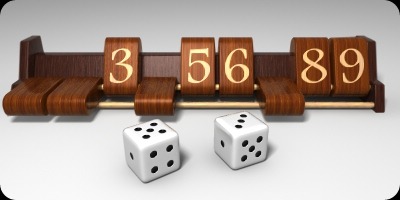
The game is typically played with some sort of contraption -- the titular “box” -- with the numbers 1-9 presented in such a way that they can be covered up. There are many mechanisms for doing this, some quite elaborate, and all completely unnecessary. You can print a free board here and simply cover the numbers up with tiny animal skins and tree bark (or whatever else you have handy). Or you could just make one yourself. It’s really not that hard.

Add two standard dice to that and you’ve got yourself a game. Maybe a dice cup if you want to get fancy, and a dice tray if you’re really up there. Or not.

Rules

The game can be played with any number of players, who will take turns rolling dice and covering numbers (or plugging leaks or what have you). Players roll the dice until they cannot cover any more numbers, at which point they receive a score based on the number left uncovered and pass the dice to the next player, who starts the process over. The lower your score (that is, the more numbers covered) the better.

Now, how you decide which numbers can be covered depends on what you roll. You must cover numbers in such a way that the sum of all the numbers covered is equal to the sum of the two dice. That’s an ugly rule, so let’s try an example: say the dice showed 4 and 1. The sum of that is 5, so you would have to cover a set of numbers that add up to 5. Any of the following would be valid:

  • 5
  • 4 + 1
  • 3 + 2

If you rolled a 6 and a 4, you’d have a slightly wider range of choices:

  • 9 + 1
  • 8 + 2
  • 7 + 3
  • 7 + 2 + 1
  • 6 + 4
  • 6 + 3 + 1
  • 5 + 4 + 1
  • 5 + 3 + 2
  • 4 + 3 + 2 + 1

Note that there’s no partial covering -- you either cover numbers to add up perfectly to the value of your roll or you don’t cover any numbers at all. If you can’t cover enough numbers to make the proper sum, you’re out of luck, and your turn is over. Whatever numbers you were unable to cover are summed and added to your score.

Choices The only available choices are 8 and 3 + 5

If you’ve already covered up the 7, 8, and 9, you can choose to only roll one die instead of two. You don’t have to, but it might be useful depending on your situation. Note that if any of those haven’t been covered, you must roll two dice.

The game is played for a certain number of rounds, and at the end of all the rounds the player with the lowest score is the winner. For a group of people this could be as few as one round; for two players you could do as many as ten -- it just depends on how long you want the game to last.

The game can also be played as a solitaire game -- just see how low you can get the score after a certain number of rounds, or see how quickly you can shut the box.